Thursday, October 29, 2009

LIMITED ACCESS II - Tehran 2009

LIMITED ACCESS II


VIDEO | SOUND | PERFORMANCE

Organized by Parkingallery in collaboration with Azad Art Gallery and Mooweex.com

Azad Art Gallery No 5, Salmas Square, Golha Square, Tehran
31 October – 4 November 2009
Daily Visiting Hours: Fri – Wed 4-8 pm
Opening night and performances: Friday 30 October, 4-8 pm

Curated by
Miha Colner / Ida Hirsenfelder (Ljubljana/SL) | Amirali Ghasemi (Parkingallery/Tehran) | Arash Khakpour (Mooweex/Tehran) | Bita Razavi (Helsinki/FI) |Sarah Rifky (Cairo/EG) | Shirin Sabahi (Malmo/SE) | Rozita Sharafjahan (Azad Art Gallery/IR)

Access to what? What limitations?

LIMITED ACCESS sounds like a disappointing title for a project, but in fact it’s not really true, it has a kind of ambiguity within it, which is a characteristic of Parkingallery projects. One should ask : “Access to what?” and “What limitations?”
In the past decade, Iranian Contemporary art and specially New Media Arts has been through many ups and downs, either in the time which was temporarily celebrated by the authorities and officials, by a considerable budget and space, without necessarily establishing a constant and appropriate structure for its survival in future, or when it visibly slowed down its development at least outside of the unofficial and private circles of artists in the recent years. And as we speak the numbers of curators and art lovers who are frequently visiting Tehran, for various reasons and intentions is highly increasing, specially now when the international Media zoomed more than ever, on Iran. The Art Market despite recent hiccups is heating up by its discoveries of middle eastern and Iranian art shows from LA to Dubai, filled with repetitive names of superstars. Meanwhile there is an independent creative scene which is emerging and is undoubtedly hard to track and describe, as its variance and its continuity lies in its anonymity. In the absence of  an inclusive reference for a proper research on multi fragmented Tehran art scene, most of the attempts which has been done to map and document the scene, remained unfinished and to some degree clueless because of the intentional shifts toward the art market and/or falling into the traps of tribal self promotional concerns of few.
LIMITED ACCESS therefore tries to gather and reconnect the artists from all disciplines to each other and reestablish their link with their emerging audience. As we believe that what is labeled and being marketed as “Iranian contemporary art” to the art world is quite known and accessible despite all propaganda, as many individuals and collectives are paying their dues for its exposure and growth internationaly, even by conflicting objectives and means. What is really missing here is a local platform, which though its structure, experiments in New Media can be seen and discussed , beyond the closed circle of the artists practicing it.
As delayed echos  of such phenomenon, often passing through mediums like Internet, books and other medias might turn the viewer into a passive consumer rather than a critical observer.
These limitations could be caused by many factors, from the imposed sanctions to unofficial boycotts, to the emergence of market-oriented attitude among artists as a result of periodic temporary reception of Iranian art all around the world, beside as some other may put it, the fact that contemporary art is being rarely mentioned in the mainstream media, ignored to some extent and not supported any more.  All these excuses are not enough to prevent us from taking the current moment for granted even if it would seem hopeless to many, and shape the future by observing and learning from it.
Amirali Ghasemi, Parkingallery Oct 2009

Jazire-ye Sargardani (The Wander Island)

(Video screening- Interactive installations-Sound )
Curated by Amirali Ghasemi
Amin Talachian | Ronak Ghoseyri | Sara Abbasian | Negar Behbahani | Ehsan Behmanesh/ Arefeh Riahi | Ali Ettehad | Ayeh Rahimi | Amirali Mohebbinejad | Negar Tahsili | Arash Fayez | Nassrin Nasser | Elika Hedayat | Arash Khakpour/ Arash Radkiya | Amirali Navaee | Bijan Moosavi | Pedram Etemadi | Siavash Naghasbandi | Sona Safaei | Tala Madani | Azin Feizabadi | Sohrab Mostafavi Kashani | Mohammad Abbasi | Peyman Abbasian | Sohrab. M Kashani | Arash Salehi /Arash Razzazian | Nima Esameilpour
Videos selected by Rozita Sharafjahan (Azad Art Gallery/IR)
Khosro Khosravi | Behnam Kamrani | Hamed Sahihi | Ghazaleh Hedayat | Samira Eskandarifar | Mohsen Rasoulov | Minou Iranpour | Setareh Jabbari | Elham Doust Haghighi | Farid Jafari Samarghandi

8513 hours in Helsinki

Curated by Bita Razavi
Eija-Liisa Ahtila | Sara Pfrommer | Katarzyna Miron | Stefan Riebel | Joonas Jokiranta | Maria Ylikoski | Linda Reif | Stefan Riebel | Gregoire Rousseau | Miina Hujala | Anna Nykyr | Hanna Marno and Leena Vahvelainen | Ewa Gorzna

(one)self as (an)other

Curated by Sarah Rifky (Cairo/EG)
Sherif Elbendary | Hassan Khan | Mohamed Allam | Mohamed Nabil | Shady El Noshokaty | Hossam Elsawah | Laila Sami

Intelligent Systems

(installations / video / multimedia / documentation)
Curated by Miha Colner / Ida Hirsenfelder
Tanja Vujinovic | Maja Smrekar | Robertina Sebjanic | Borut Savski | Lada Cerar & Saso Sedlacek | Vladimir Ristic | son:DA & Erinc SeymenTomaz Furlan | Neven Korda | Saso Podgorsek | Marko Kovacic & Kolja Saksida | Ana Sluga | Jaka Zelelznikar

Whoever I Like Turns out to be a Weirdo, or Performative Narrations

(video screening)
Curated by Shirin Sabahi
Kevin Murphy | Tamar Guimarães | EllaKajsa Nordström | Henning Lundkuist | Stine Ofelia Kildevang | João Leonardo | Annette Stav Johansson | Maj Hasager | EllaKajsa Nordström | Wattanai Chanakot | Ana Bezelga | Kristina Kvalvik | EllaKajsa Nordström | Maria Lusitano Santos | Hanna Paulin | Hanna Sjöstrand | Lara Morais

Saturday, October 03, 2009

the NEW parkingallery


Parkingallery is changing from an E- gallery/ nice looking static website to a multifunctional blog / news portal on Iranian and international contemporary arts and design… this decision has been made through around a year of less frequent activities on our website focusing on other projects including the our monumental mega exhibition in a suitcase: URBAN JEALOUSY/The roaming biennial of Tehran . There are other reasons to shift our activities from plain showcasing up and coming artists to a more advanced way of paying our due to the community of Iranian involved with arts, to name a few:

1st of all because of the fact that the way we Iranians are dealing with Internet phenomenon and its fabulous growth in Iran despite obstacles raining from everywhere (!), we are encouraging our artists friends to setup their own personal websites and try our best to help them both as design studio and a project space to promote and maintain their website while benefit from being linked and featured in our refreshed website.

Secondly despite we’ve never have been acting as a commercial gallery, an increasing numbers of the artists used to work with us did or about to sign restricting contracts with individual, institutions and galleries,which made us think to refresh what we has been showing on our website for over a decade, to be experimental and less conventional and more and more away from sophisticated mainstream trends, and more importantly focused on new media art projects and knowledge production it the field of interdisciplinary practices.

we believe that current circumstances forces by various players in the scene made circulation of the art and its makers and contributors in Iran going through severe unfair issues, caused many talented young artist to be ignored to to fall into early professionalism which kills their interest and reduce their intention for experimental projects and practices, having said that what is really a nessesity of our time is building up an news portal/idea exchange pool which aims to track what’s happening now in the art scene by documenting see-worthy happening and events and what has been through by interviewing the key figures in the field, helping us to discover the lines between the lines of unwritten history of our own! ( wow what a big claim!)

Finally to find practical way to make parkingallery’s archive on contemporary arts, which has been evolving through the years, available online and to public.

To make all this happen, we are looking for contributors from around the world who are interested in the arts and its universe to join our team and/or help us as freelance reporters and photographers, we will write more about this call, very soon.

That’s all for now…

Warm wishes from Parkingallery’s Headquarter

Parkingallery Team

Sunday, April 19, 2009

Scraps, a poster exhibition by Behrad Javanbakht


"Scraps"
A poster collection designed by "Behrad Javanbakht" will exhibit at "Morteza Momayez" gallery of "Iranian Artists' Forum".
This is the first solo exhibition of this artist that will be opened on Saturday April 18th 2009, at 17:30 till April 22nd.
"Iranian Artists' Forum" is placed in Baghe Honar, Mousavi St., Taleghani Ave., Tehran, Iran.
Visiting hours: 10:00 to 20:00

This exhibition is collaborated by "Iranian Graphic Designers Society" and is sponsored by "Print and design house" co., "Media" design consultant co., Maryam Soft co., Avajang ICT group, "Dara" prints studio, "akkasee" website and "Rang" e-magazine.


Monday, February 09, 2009

Shopping Malls by Saghar Daeeri


Shopping Malls
Painting Exhibition by Saghar Daeeri
13-19 February 2009
16:00 - 20:00
Azad Art Gallery
No 5, Salmas Sq, Golha Sq, Tehran, Iran

Tel: +98 21 8800 8676
Poster designed by Iman Raad


Saghar Daeeri 2008, Tehran Shopping Malls, 100x150 CM acrylic on canvas

Friday, January 23, 2009

Present Perfect Tense: Shirin Sabahi at KHM Gallery

KHM Gallery
Ystadvägen 22A, Malmö
31 January – 14 February 2009
Tuesday to Sunday, 13:00 – 17:00
Opening Friday 30 January, 17:00 – 21:00
Artist Talk Thursday 05 February, 15:00

In Present Perfect Tense Shirin Sabahi works with moving images, examining old and current views of image production by using an objet trouvé – 8 mm format home movies by a Swedish pre-war journalist. In the film, Present Participle, through a voiceover Sabahi reveals different narrative positions. The speaking subjects are real and fictitious, oscillating between the author of the artifacts, the author of the artworks and a third party – the archivist, who is also the journalist's son. In Present Perfect Tense images of the past – mainly of Paris and middle-class Sweden before the Second World War – are transformed into a critique of the present. The use of different narrative positions articulates the complicity of these voices and time periods. The film becomes a visual biography that challenges the original author of the footage, the Swedish tourist. At the same time it shifts our focus from the personal towards the collective, speaking of both cosmopolitan and nationalist politics and the ways in which they manifest in personal narratives.

Stills from the film are also presented, as arbitrary visual quotes. One slide show called Past Simple captures faces glancing into the camera. The other three black and white slides under the title Past Participle confront us with the protagonist of the films and thereby brings the 'present tense' to the fore. Present Perfect Tense is a playful experience with different forms of gaze and voice, which ultimately acknowledges us, the audience.

Emese Suvecz

For more information and selected high-resolution images for publicity use please contact: info@shirinsabahi.com

MARCOPOLO Exhibition by Hamed Sahihi

MARCOPOLO
Exhibition by Hamed Sahihi
30 Jan - 11 Feb
Visiting Hours: 4-8 pm
Opening Friday 30 Jan

Azad Art Gallery

No 5 Salmas sq, Golha sq, Tehran- IRAN


Khan wonders when Polo has had time to travel. It seems to him that Polo has never moved from the garden. Polo responds that everything he sees and does assumes a meaning in a place like where they sit. When he concentrates and remembers he is always in this garden in the emperor's presence, even though he continues without pausing up a river. Khan is no longer sure if he is sitting in the garden or riding through the lands that Marco is describing. Polo suggests that the garden may only exist in their minds and that their travels have not yet ended. Each time they partially close their eyes they are allowed to return to the peace of the garden. Khan wonders if this dialogue is actually taking place between two beggars with imitation names, Khan & Marcopolo.

Saturday, December 20, 2008

The Massive Calm


The Massive Calm
Painting exhibition by Samira Eskandarfar
26th - 31st Dec, 2008.
visiting hours : 16 - 20 p.m.
No. 41 Fatemi Sq. Golha sq. Salmas sq. Tehran Iran,
Tel: +98 21 88008676
Website: http://www.samiraeskandarfar.com/

Poster Designed by Amirali Ghasemi

Friday, November 14, 2008

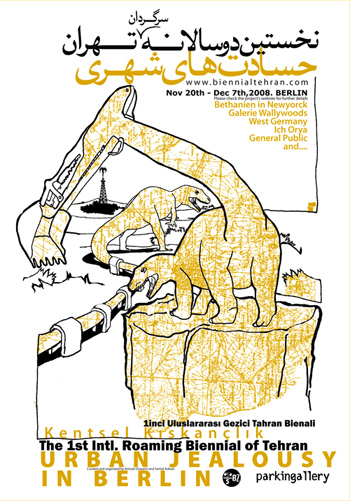
Urban Jealousy in Berlin


Urban Jealousy in Berlin

The 1st International Roaming Biennial of Tehran, Berlin
20 Nov.2008 - 7 Dec. 2008
Urban Jealousy in Berlin

International Roaming Biennial of Tehran, curated and organized by Amirali Ghasemi and Serhat Koksal,chose Istanbul as its first station .The idea of this independent, low-budget exhibition started out both as a critique of the situation in Tehran, and of the international " Biennialization" and '' Gentrification '' process.
Featured works by artists from different countries from all around the world, selected from an open submission call, which
has had an overwhelming response.Berlin is it's 2nd station.

Saturday, October 25, 2008

Sideways in Tehran


Sideways in Tehran

------------------------------------
with works and contributions from:

Bassam Chekhes

Atousa Bandeh Ghiasabadi

Katrin Korfmann

Sara Blokland

Nickel van Duijvenboden

and
Tina Rahimy

------------------
How does a shift in the context of a piece of art influence its ability to be recognized and the validity of the work? How can art be judged from another culture? Is quality universal?

These questions are the starting point of the project Sideways.


Atousa Bandeh Ghiasabadi
/ Visual Artist/ Film Maker asked 5 artist and writers to research this questions and produce an artwork to be presented in two different exhibitions one in Tehran and in the Netherlands and finalized with a Publication(book).
Sideways in Tehran will literary replacing the context.
Bandeh being part of a minority group with a non-western background in the Netherlands often questioned the comprehensibility of her work by the western audience not familiar with her cultural history. Now she will reverse the process by exhibiting works of a group of artist in the context which is familiar to Bandeh but not to them. In this she hope to find out a more objective approach through her own experience but also through the experiences by participants of Sideways.

Katrin Korfmann / visual artist, living in Amsterdam, NL
Katrin Korfmann is analyzing the often-quoted ´magic moment´ of photography. Or we could say she plays with it. The time factor of the ´magic moment´ is stretched, deconstructed, duplicated and subsequently assembled.She observes places of daily life, humans and machines, stages of public space.
Finally the space and the experienced time at the location is documented en coded again to a location never experienced like this. The image is document and invention at the same time.

For the project sideways Korfmann relates to her hometown West-Berlin (Germany) and the change of the city since the wall came down. The photograph fast forward (Checkpoint Charlie) 145 x 253 cm
is showing a crossing point between former East and West Berlin. 20 years after the cold war this spot is one of the most demanded tourist attractions of the city. Fake American and Russian soldiers play theatre there. They sell visas with stamps and are bargaining over original gasmasks and GDR flags.
For money one can pose with the soldier to get the most wanted holiday snapshot.
The monument of the cold war becomes a funny game. A busy movement, a film set, where visitors try to catch the spectacular moments of German history.

Sara Blokland / visual artist
Her works often explores the representation of the concept of family, exploring the confusion and ambiguity between the personal and impersonal. As a artist she interested in deconstructing the exotic subject, and reconstructing new ones. Her photographic images challenge the exotic presumptions of the dominant culture. How is the exotic part of the representation of the Western artist in the search for a ‘’original view’ and understanding the subject..In two short films ‘’Brother’’ and ‘’Roos’’, she will reflect on photography as a ''exotic'' object and incorporating the personal experience of one viewer and photographer.

Nickel van Duijvenboden Photographer/writer turned from photography to writing and is operating in the grey area between visual art and literature. He uses his experiences as a former member of a punk band as a point of departure for a short fiction — punk being a highly idealistic, non-conformist subculture which is supposedly Western (or is it?). In Teheran, he will combine photographs with a text about one particular aspect of his experiences."

Bassam Chekhes (Syria, 1965) Film Maker graduated from audiovisual department at the rietveld academy and mainly is making short films.The subjects of his films are related to his personal surrounding and have a direct contact with his own experience, as if they are a dairy or a biography.He prefers to work with different images as the starting elements for his films rather than text or a complete script, and to experiment the relation between the subject of the film and the related form that finally get."

Tina Rahimy philosopher researching at Erasmus university Rotterdam

Her research will focus on the choice of literature as a form of expression. Why do strangers, like refugees choose to write, why do they choose language of the host country? Language, the most demanding element, the crown witness of our alienation, not only in its content but also in its form. Do these writers however believe in the deficiency of their speech, or rather acknowledge the hesitation in and of a language as and characteristic element of any speech?

Sideways is sponsored by Visual Arts, Architecture & Design fund Netherlands Fonds BKVB
The exhibition is organized & curated by Amirali Ghasemi
Sideways project is a project by Atousa Bandeh Ghiasabadi Artist/Filmmaker Intendant for Cultural Diversity,
Sideways started in 2007 and will be finalized by presenting a book and an exhibition in the Netherlands in 2009.

Poster is designed by Behrad Javanbakht for Parkingallery Studio.

Saturday, June 14, 2008

Watch the Moon

Watch the Moon
Audio Performance
Javad Safari

20-25 June 2008
Performance Hours: 18-20
Opening: Friday June 20th:16-20
Azad Art Gallery
No 41,Salmas Sq. Golha Sq. Tehran,Iran|
Tel: +98 21 88008676

Performers:
Soheil Peyghambari / Clarinet
Daryoush Azadpour / Violin Alireza Favakehi / Violin
Shahriar Khansari / Viola
Alireza Mahammadinia/ Cello
Mohammad Javad Safari / Keyboard

Video Works: Arash Khakpour

Poster designed by
Amirali Ghasemi for
Parkingallery studio

Friday, May 09, 2008

UNDERGROUND at Azad Gallery


UNDERGROUND
an exhibition by Hamed Sahihi and Samira Eskandarfar
Opening: Friday 9th of May 2008 , 4-8 pm
9-14 May 2008
4-8pm
Azad Art Gallery
No. 41,Salmas Sq, Golha Sq,Tehran

Saturday, April 26, 2008

New poster printed in slik screen

Unofficial Methodology of Nationwide Census
100x70 cm, 2 color silk screen
Designed by Amirali Ghasemi
Printed at Dara Print Studio check their blog to see more posters link

Monday, March 24, 2008

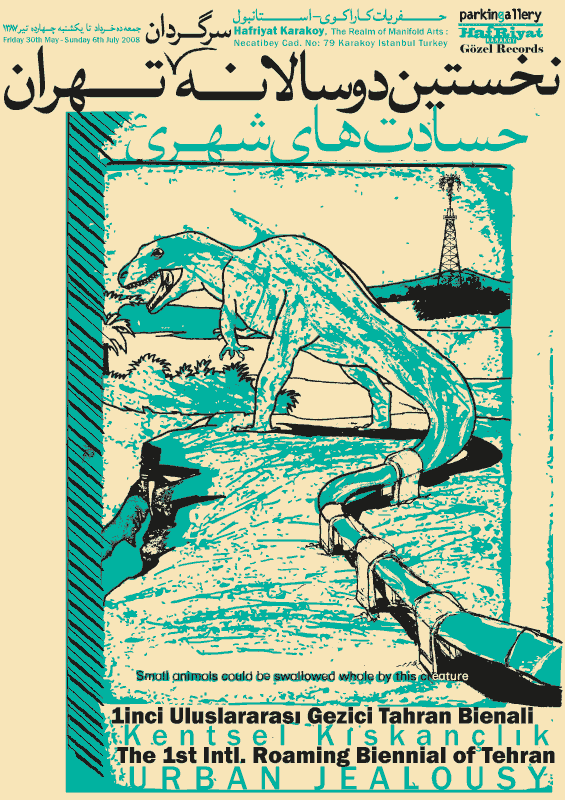
Call for art the 1st International Roaming Biennial of Tehran

Urban Jealousy
the 1st International Roaming Biennial of Tehran
30th May - 6th July 2008
Curated by Serhat koksal and Amirali Ghasemi

Download the Application in WORD documents here (Choose Your Langugae)
Farsi, French, English and Turkish

Dead line: Monday 21st of April 2008


The theme of this biennial is URBAN JEALOUSY. A Jalousie * (“jealousy” in French) is a window that one can see through but not be seen; barriers that allow us to observe the world without being invited to the table. Iranian artists are given an understanding of what goes on in the world without being offered a single opportunity to communicate their thoughts—outside of our very own jalousie window: a rigid ethnic frame within an extremely politicized context.

Of all the huge urban areas around the world, Tehran stands out as a different kind of Megalopolis. It boasts one of the most dynamic art scenes in the Middle East even as the city itself deals with a rudimentary public transport system, an exploding population crisis, and an ever-increasing sprawl of mass housing; An unsightly city of experimental architecture that swallows entire villages and towns without offering them any sort of public services.

Despite its complicated urban situation—which according to experts has already spiraled out of control—artists’ societies in Tehran continue to hold numerous biennials in semi-tribal fashion. A great number of these events are government-sponsored projects whose outlook and also their premises can shift 180 degrees from one year to the next. Each community has its own set of ceremonies, as a result of which, any sense of solidarity among the artists is lost.

The Tehran Visual Arts Festival, The Calligraphy Biennial, The Sculpture Biennial, The Cartoon Biennial, The Painting Biennial of the Islamic World, The Graphic Design Biennial, The Children’s Books Illustration Biennial, The Painting Biennial, The Poster Biennial, The Poster Biennial of the Islamic World… the list is endless.

Although the legendary "TEHRAN BIENNIAL" goes back 50 years, not a single one of the above-mentioned events can be considered a biennial by prevailing and accepted international standards". An arts society recently published a call to boycott the upcoming Painting Biennial in order to demand a professionally curated exhibition, protesting the open call process and a “jury” they deemed unacceptable.

It seems impossible to have a proper Tehran biennial in Tehran, so our sprawling city and its elitist art scene remain excluded from the highly competitive art market in the region despite being surrounded from all sides by lucrative biennials and auctions. We may have great artists living and working in Iran, but we don’t have a chance to share the profits.

Tehran, as one may suppose, does not seem interested in presenting itself as a desirable destination for cultural tourism, by playing it ‘cool’ like other global cities, or scramble to be hip by coughing up the membership dues to be in the international art market.

So, to jumpstart the process, and after a long discussion with my friend, Serhat Koksal — a critic of the global biennialization process — we decided to curate a ‘mini’, on the move, Tehran biennial. To not only stop complaining about the current situation but to benefit from the advantages of it. An independent, low- budget, traveling exhibition which can be presented almost anywhere. We will travel like nomads, carrying artwork, objects, texts, and whatever, in a package no bigger than a medium-sized suitcase, preferably weighing less than 20 Kg., so it can be carried on any cheap flight.

Urban Jealousy will end its journey in May 2010,but Tehran’s Roaming Biennial will carry on.Feb 2008

Saturday, March 08, 2008

“philosophers’ beds/bedding philosophers” by Gloria Zein


Do philosophers poud in bed? Or do they invent there great ideas about the world outside, just before falling asleep, covered with stakes of books and papers?

Philosophy is pure thought. Clean, abstract, bodyless.

Beds, on the contrary, are very specific. Our journey into the world starts in a bed, and it mostly ends there when we die. We relax our tired bodies, hide, sleep and dream in the bed. Here, it seems, we are the most reduced to our physical existence. The bed is our most personal place.

The German artist Gloria Zein has put these two worlds, the bed and philosophy, in a relationship: For more than two years she has interviewed international philosophers about their thoughts around the bed – in order to dedicate an individual object to each of them. Ten “beds” representing this ongoing investigation can now be viewed at the Iranian Artists’ Forum, alongside drawings, photographs and texts. Her inventions range from the metaphorical to the poetic and humorous.

We would like to cordially invite you to the opening of
“philosophers’ beds/bedding philosophers”

by Gloria Zein

Mirmiran Art Gallery at the Iranian Artists’ Forum
Sunday, March 9th 2008
17:00 to 20:30

The artist as well as Simon Farid O’Liai, Iranian philosopher participating in Zein’s project, will be present at the opening.
The exhibition will run until March 13th. Daily visiting hours 14:00 to 20:00.

Poster Designed by Amirali Ghasemi

Sunday, October 28, 2007

The Dispersion


The Dispersion


An exhibition by Hamed Sahihi and Samira Eskandarfar
Mah Art Gallery
Nov. 10-20, 2007
Visiting Hours: 3-7 pm
No 89, Golestan Blvd. , Africa Ave. ,Tehran
TeleFax: 22045879

پراکنــــــــــــــــــــــــــــــــــــــــــــــــــــدگی
نمایشگاهی از حامد صحیحی و سمیرا اسکندرفر

نگارخانه ماه
نوزدهم تا بیست ونهم آبان
ساعات بازدید: سه تا هفت عصر
تهران، خیابان آفریقا (جردن)، شماره هشتاد و نه

طراح پوستر: امیرعلی قاسمی
Poster Designed by Amirali Ghasemi

Thursday, October 18, 2007

NEVER BEEN TO TEHRAN

NEVER BEEN TO TEHRAN
October 19 - November 16, 2007

(photo credits clockwise from top left: Sal Randolph, USA; Heidi Hove Pedersen, Denmark; Greg Halpern and Ahndraya Parlato, USA; Otto Von Busch, Sweden and Turkey; France Martin Krusche, Austria; Jon Rubin, USA; Keiko Tsuji, Japan; Iyallola Tillieu, Belgium)

EXHIBITION VENUES: Parkingallery, Tehran, Iran; Caravansarai, Istanbul, Turkey; San Francisco Arts Commission Gallery, San Francisco, USA; Media and Interdisciplinary Arts Center, Auckland, New Zealand; Koh-I-Noor, Copenhagen, Denmark; Mess Hall, Chicago, USA; Pittsburgh Cultural Trust (Downtown Electronic Jumbotron), Pittsburgh, USA; ; Embryosalon, Berlin, Germany; and live on the web at WWW.NeverBeenToTehran.COM

NEVER BEEN TO TEHRAN, organized by artist Jon Rubin and curator Andrea Grover, is a worldwide exhibition with 29 international participants who will be contributing photographs of what they imagine the city of Tehran to look like, to a universal photo-sharing website. The photographs will be streamed to each exhibition venue as a continuously evolving slideshow, with more photographs being uploaded daily throughout the exhibition. The participants will use a variety of research methods to imagine the culture, landscape, and people of Tehran, using only their primary city of residence as the location of their photographs.

Exhibition Description Imagine a city that you've only seen in reproductions or perhaps have merely heard about. A place, like many others, that only exists for you through indirect sources--the nightly news, hearsay, literature, magazines, movies, and the Internet. Using these secondhand clues as firsthand research materials, invited worldwide participants--who have Never Been to Tehran--will take photographs (from their home base) of what they imagine Tehran to look like. Contributors will upload their photos daily to an on-line photosharing site, which will be projected as a slideshow simultaneously in galleries and public spaces around the world (including Tehran). Anything that anyone might take a photograph of is fair game, just as long as it feels like Tehran.

For the international contributors to this exhibition, the task is to search through their daily lives for clues to a foreign place, for the possibility that somewhere else exists right under their noses and that, like some clunky form of astral projection, one can travel to other lands without leaving home. New information technologies are expanding the possibility of knowing a place to which you've never traveled. Hosts of amateur and commercial websites and podcasts about a given city, its economy, demographics, culture and subculture have opened the way for a new vernacular of representation.

As Tehran's image is regularly depicted in the dominant media, it is a compelling challenge for the participants in this exhibition to sift through the glut of images and information to cull out a personally constructed version of an unfamiliar place. For viewers in Tehran, the exhibition presents a chance to witness an unusual mirroring of their globally projected image, taken from the daily lives and environs of outsiders. Collectively, the artists and viewers of Never Been to Tehran will be charting a liminal space stuck somewhere between here and there that in our contemporary existence just might be home.

Participants: Dean Baldwin, Canada; Aideen Barry, Ireland; Cedric Bomford, Canada; Otto Von Busch, Sweden and Turkey; James Charlton, New Zealand; Sara Graham, Canada; Andrea Grover, USA; Deniz Gul, Turkey; Greg Halpern and Ahndraya Parlato, USA; Levin Haegele, England; Rumana Husain, Pakistan; Jun'ichiro Ishii, France; Martin Krusche, Austria; Rosie Lynch, Germany; Francesco Nonino, Italy; Elena Perlino, Italy; Heidi Hove Pedersen, Denmark; Sal Randolph, USA; Alia Rayya, Israel/Palestinian Territories; Jon Rubin, USA; Jakob Seibel, Germany; Iyallola Tillieu, Belgium; Keiko Tsuji, Japan; Lee Walton, USA; Lindsey White, USA; Christian Sievers, Germany; Zoe Strauss, USA

Saturday, June 09, 2007

Parkingallery | screening : From the Fluxfilms Anthology (USA, 1966


Image: George Maciunas, Fluxmanifesto (1963)
Film screening: From the Fluxfilms Anthology (USA, 1966)
with an introduction by Ms. Media Farzin
Monday, 7-9 pm
at
Parkingallery
No.11, 4th Milad Alley,Milad street, Dadman Blvd. Farahzadi Blvd. Shahrak-e Gharb.Tehran
Tel: 88 57 97 27

Between 1965 and 1968, artist and designer George Maciunas put together
a collection of film loops that he called the "Fluxfilms Anthology." A
group of about 20 experimental shorts, they were intended to be
screened as films and as backgrounds to performances. Maciunas was the
organizer and driving force behind the artist collective known as
Fluxus. Their publications, performances, instruction works and
objects were mainly produced in the 1960s in New York, but included
events and collaborations in Europe and Japan.

"Fluxfilms, especially when taken in context with other Fluxus
performances, insisted on gradual deconstruction not only of the
various components of the cinematic apparatus, but of cinema itself.
After eliminating the projector, there is nothing left but the
screen.... With the traditional movie space eliminated, the viewer
'generates' his or her own screening situation.... Finally, the viewer
becomes producer."
- Tod Lippy, "Disappearing Act: the Radical Reductivism of Fluxus Film"

Sunday, April 15, 2007

Treibsand DVD magazine launches officially in Tehran

The 1st issue of Treibsand DVD magazine: "[Analysing while Waiting (For Time To Pass)] contemporary art from Tehran" launches officially in Tehran on 17th of April.
Concept by Curator, Susann Wintsch & Artist, Parastou Forouhar

Venue: Azad Art Gallery, No 41 , Salmas sq., Golha sq., Tehran +(98)(21)88008676
Time and Date: 17-19 April , 408 pm

Featuring Artists :
Iman Afsarian| Nazgol Ansarinia| Mehraneh Atashi| Mahmoud Bakhshi-Moakhar| Shahrzad Darafsheh| Samira Eskandarfar| Farhad Fozouni| Nina Ghaffari| Amirali Ghasemi| Barbad Golshiri| Arash Hanaei| Ghazaleh Hedayat| Elahe Heidari| Behnam Kamrani| Simin Keramati| Khosro Khosravi/Farid Jafari| Mehran Mohajer| Ahmad Morshedlou| Neda Razavipour /Shahab Fotouhi| Hamed Sahihi| Rozita Sharaf Jahan| Jinoos Taghizadeh| Sadegh Tirafkan

Statements from:
Iman Afsarian| Haleh Anvari| Khosrow Hassanzadeh| Sohrab Mahdavi| Ruyin Pakbaz| Alireza Sami Azar| Soghra Zare Anaghezi|

Poster Designed by Farhad Fozouni

Friday, April 06, 2007

Analysing while Waiting (For Time To Pass)

Treibsand [Volume 01], contemporary video art from Teheran

04/26/07, 20:00

Curator Susann Wintsch presents the DVD Treibsand with contemporary video art from Teheran.
TREIBSAND [VOLUME 01] «Analysing while Waiting (For Time To Pass)» sheds light on contemporary and emerging art in Tehran, concentrating predominantly on an analytical stance in times of waiting. Waiting for the future may be expressed as yearning or depression, or it may appear as a long, protracted period in which past and present are analysed in depth from a personal and post-colonialist viewpoint. The concept has been drawn up in close collaboration with Parastou Forouhar (Frankfurt am Main/Tehran).

Artists
Iman Afsarian, Nazgol Ansarinia, Mehraneh Atashi, Mahmoud Bakhshi-Moakhar, Shahrzad Darafsheh, Samira Eskandarfar, Farhad Fozouni, Nina Ghaffari, Amirali Ghasemi, Barbad Golshiri, Arash Hanaei, Ghazaleh Hedayat, Elahe Heidari, Behnam Kamrani, Simin Keramati, Khosro Khosravi/Farid Jafari, Mehran Mohajer, Ahmad Morshedlou, Neda Razavipour /Shahab Fotouhi, Hamed Sahihi, Rozita Sharaf Jahan, Jinoos Taghizadeh, Sadegh Tirafkan

Statements
Iman Afsarian, artist and editor; Haleh Anvari, artist and journalist; Khosrow Hassanzadeh, artist; Sohrab Mahdavi, editor of TehranAvenue.com; Ruyin Pakbaz, art and art history professor; Alireza Sami Azar, curator; Soghra Zare Anaghezi, artist

Sunday, March 18, 2007

Never Been to Houston

Never Been to Houston
March 9-April 14
Lawndale Art Center, Houston, Texas
Curated by Aurora Picture Show and Jon Rubin

Imagine a city that you've only seen in reproductions or perhaps have merely heard about. A place, like many others, that exists only through rumors, stories, novels, the nightly news, magazines, movies, and the Internet. Using these secondhand clues as firsthand research material, invited worldwide contributors-who have Never Been to Houston- will photographically document (without leaving home) what they imagine Houston to look like. Contributors will upload their photos daily to an on-line Flickr site, which will be projected as a slideshow in Houston's Lawndale gallery. Anything that anyone might take a photograph of is fair game. Just as long as it feels like Houston.

For the contributors to this exhibition, the task is to search through their daily life for clues to a foreign place, for the possibility that somewhere else exists right under their nose and that, like some clunky form of astral projection, you can travel to other lands without leaving home. For viewers in Houston, it's a chance to witness an unusual mirroring of their globally projected image. In addition to the traditions of storytelling and travel guides, new information technologies are expanding the possibility of knowing a place to which you've never traveled. Three-dimensional electronic maps, 360 degree images, hosts of amateur and commercial websites and podcasts about a given city, its economy, demographics, culture and subculture have opened the way for a new vernacular of representation.

In the end, Never Been to Houston is an experimental, virtual travelogue to the city that the New York Times opines "refuses to assume a simply identity."

Amirali Ghasemi from parkingallery is also one of the invited contributers.